Seventeenth Sunday in Ordinary Time/A
Massimo Palombella
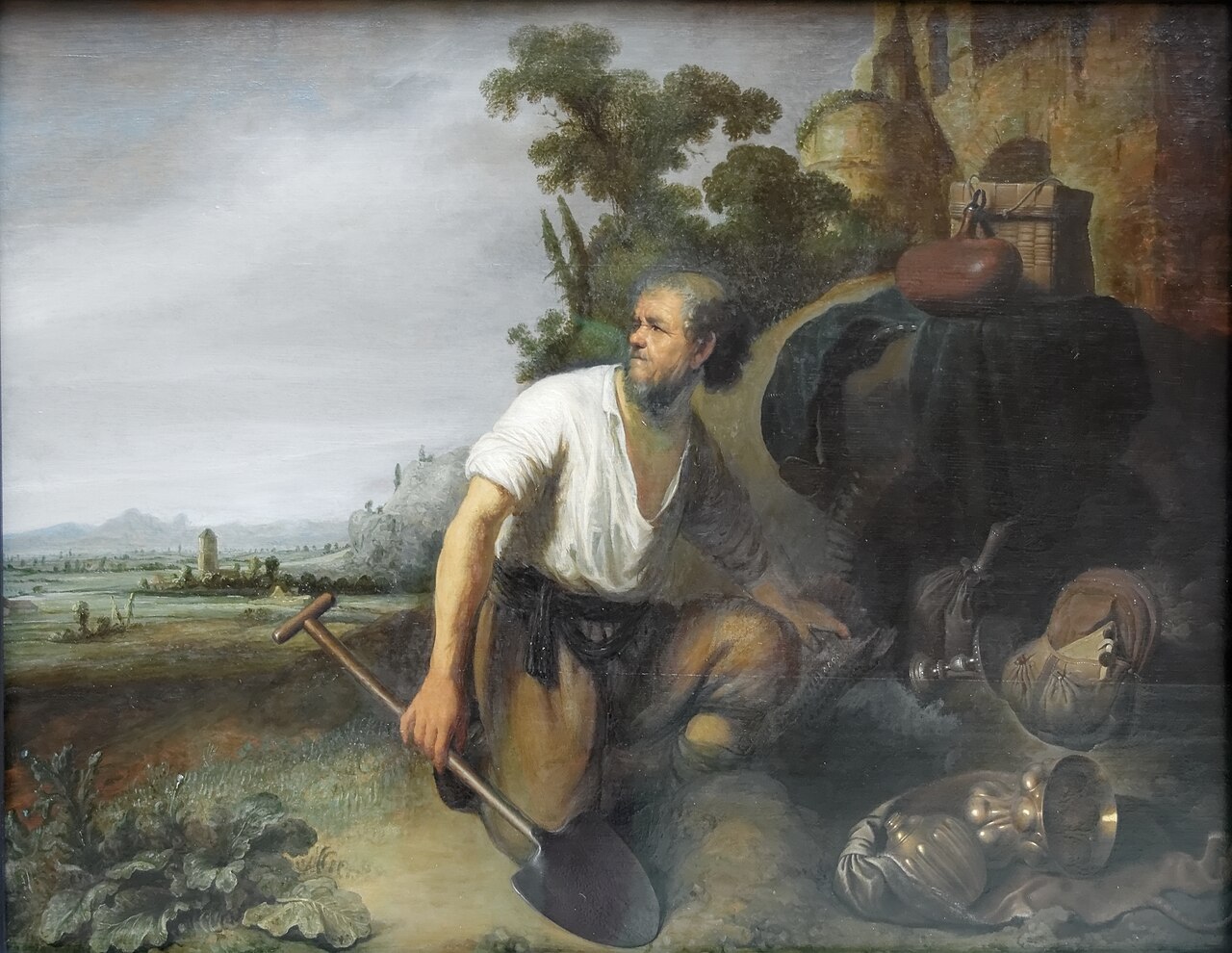
In today’s Gospel (Matthew 13:44–52), Jesus tells three brief parables woven together by a single thread: the discovery of something that radically transforms a person’s life.
The first speaks of a treasure hidden in a field. The Evangelist describes it as κεκρυμμένος (kekrymmenos), the perfect participle of the verb κρύπτω (krýptō), “to hide”. It does not denote something that does not exist, but rather a reality that is already present and yet remains concealed until someone discovers it. It is an image of our truest life: it already exists, but awaits the moment in which it is found.
When that happens, everything is seen from a new perspective.
The man, indeed, “out of his joy” (ἀπὸ τῆς χαρᾶς αὐτοῦ – apò tês charâs autoû), sells all that he possesses and buys that field. The verb πωλεῖ (poleî), “he sells”, expresses a definitive decision, one that admits of no second thoughts. He keeps no alternatives in reserve and leaves no escape route open. His life has found a new centre of gravity.
Such is the dynamic of every genuine falling in love.
When one truly loves, life is no longer lived by calculating what has been lost and what has been gained. Love places our existence into another orbit. Many things are left behind, not because they have been imposed as sacrifices, but because, in the light of what has at last been discovered, they have quite naturally lost their former worth.
This is why the Gospel does not say that joy is born of having sold everything. It says precisely the opposite: it is the treasure that has been found which makes it possible to sell everything. Renunciation does not give birth to love; rather, it is love that renders renunciation natural.
Perhaps the deepest question of our existence is not what we are required to renounce, but what we have truly found. For only the one who discovers a “treasure” — someone or something for which life is genuinely worth living — ceases merely to survive and begins, at last, to live.
Only then does our life become a life truly worthy of being lived.
The Communion Antiphon for today’s celebration is taken from Chapter 13 of the Gospel according to Saint Matthew (Matthew 13:45–46), with the following text:
Simile est regnum caelorum homini negotiatori, quaerenti bonas margaritas:
inventa una pretiosa margarita, dedit omnia sua, et comparavit eam.
(The kingdom of heaven is like a merchant in search of fine pearls;
on finding one pearl of great value, he went and sold all that he possessed and bought it).
The accompanying chant is taken from the Graduale Triplex, published at Solesmes in 1979. The performance is by the Mönchsschola der Erzabtei St. Ottilien, directed by Johannes Berchmans Göschl. This recording is included on the CD Gregorian Chants, released by Naxos of America in 2014, and may also be heard here.
A blessed Sunday and heartfelt greetings.