Twenty-Ninth Sunday in Ordinary Time/A
Massimo Palombella
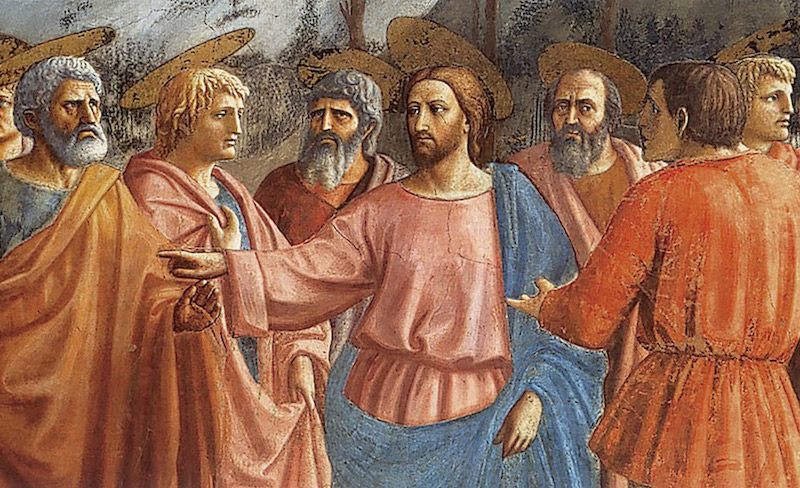
In today’s Gospel (Matthew 22:15–21), Jesus utters the familiar words: “Render to Caesar what is Caesar’s, and to God what is God’s.” Yet perhaps we have become so accustomed to this saying that we no longer perceive the full force of the words Jesus chooses.
The Greek verb is ἀπόδοτε (apódote), from ἀποδίδωμι. It does not simply mean “give”, but, more precisely, “give back” or “return”. Return to Caesar what belongs to Caesar, and to God what belongs to God.
Certainly, these words may be understood in terms of the relationship between the civil and religious spheres, between the State and faith. Yet I believe that, before anything else, they confront us with a far more profound question concerning the reality of the God in whom we profess to believe.
Indeed, just before this, Jesus takes the coin in his hand and asks: τίνος ἡ εἰκὼν αὕτη καὶ ἡ ἐπιγραφή; (tínos hē eikṓn haútē kaì hē epigraphḗ?), “Whose image is this, and whose inscription?” The decisive word is εἰκών (eikṓn), “image”. The coin bears the image of Caesar and may therefore be returned to Caesar. Yet, against the background of Scripture as a whole, the human person bears within himself another image: that of God.
And so the question becomes infinitely more searching: what must I give back to God? Not something. Not one particular area of my existence. Not a few religious observances. I must give God back my very self, because my humanity itself belongs to him.
This is why faith, our relationship with God, necessarily entails a concern for our humanity: the two are as inseparable as the two sides of the same coin. If the God in whom I claim to believe does not lead me towards maturity, does not help me face my problems, live with my weaknesses and accept them; if he does not compel me to be truthful with myself and to stop living a lie; if he does not gradually make me freer and more authentic… then perhaps such a god does not exist at all. Perhaps he is merely a construct of my own making, designed to sustain an existence in which everything appears to be comfortably “in order”.
The second reading expresses this in strikingly concrete terms. Paul speaks of the ἔργον τῆς πίστεως (érgon tēs písteōs), the “work of faith”, and the κόπος τῆς ἀγάπης (kópos tēs agápēs), the “labour of love” (1 Thessalonians 1:3). Faith, then, has an ἔργον, a work: it brings something into being. And love involves κόπος, toil and effort. There is nothing abstract here, nothing merely reassuring or consoling.
In other words, if my faith does not also lead me to become a better professional — someone who continues to study, keeps abreast of new developments, questions certainties long taken for granted, refuses to settle for what has already been achieved, and constantly strives for greater excellence in his work; if it does not make me more responsible in my relationships, more serious about my choices, freer from my fears and from the compensations to which I turn… then perhaps this kind of “faith” serves only to keep me enclosed within a sort of protective bubble, shielding me from reality and holding it at a distance. It creates the illusion that I am truly living, when, if I am honest with myself, it scarcely allows me to do more than survive.
If the God in whom I believe is true, if he is real, then he must necessarily set my life in motion. He does not remove me from reality, but restores me to it. He does not magically resolve my problems, but enables me to find my way through them. He does not take away my frailties, but teaches me to acknowledge them without becoming their prisoner. He does not exempt me from the demanding task of becoming an adult, but leads me — not without difficulty, effort and even suffering — towards that “life in abundance” in which I may gradually become the person I am called to be.
At so many moments in our lives, we can all be tempted to dispense with one side of the coin. We may surrender ourselves to a god who does not exist, a god fashioned to protect us from reality. Or we may persuade ourselves that our work, our professional competence, the things we accomplish, the results we achieve and the successes we accumulate are enough to give meaning to our existence and make us genuinely happy.
Today’s Gospel seems to tell us that neither path is sufficient.
“Render to Caesar what is Caesar’s, and to God what is God’s.”
Perhaps this is precisely the decisive question: learning to recognise to whom the things we hold in our hands truly belong. The coin bears the image of Caesar. But we bear another image.
And, ultimately, we can give back to God nothing less than our very selves.
The Entrance Antiphon, or Introit, of today’s celebration is taken from Psalm 16 (Ps 16:6, 8) and has the following text:
Ego clamavi, quoniam exaudisti me, Deus: inclina aurem tuam, et exaudi verba mea:
custodi me, Domine, ut pupillam oculi: sub umbra alarum tuarum protege me.
(I call upon you, O God, for you will answer me; incline your ear towards me and hear my prayer.
Guard me, O Lord, as the apple of your eye; shelter me beneath the shadow of your wings).
The accompanying Gregorian chant is taken from the Graduale Triplex, published at Solesmes in 1979. The recording is available on YouTube, where no information concerning the interpretation is provided.
A blessed Sunday and heartfelt greetings.