Twenty-Seventh Sunday in Ordinary Time/A
Massimo Palombella
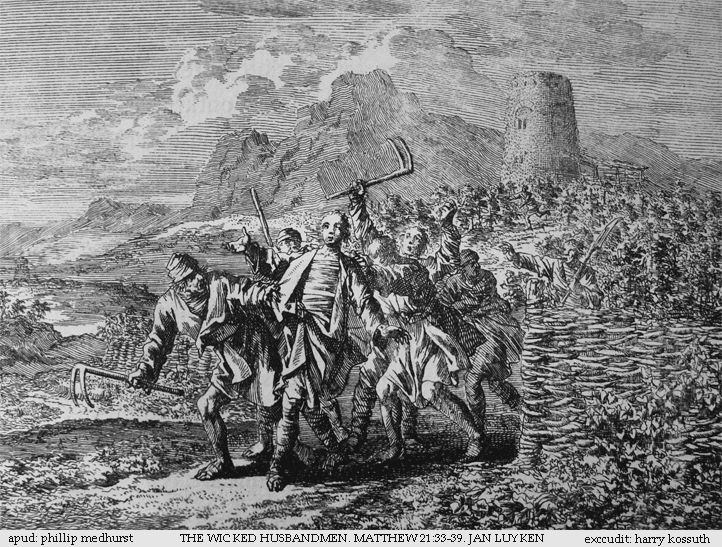
In today’s Gospel (Mt 21:33–43), Jesus returns once again to a parable whose defining image is that of the vineyard.
This time, the vineyard is entrusted to tenants so that they may bring forth its fruit. And it is precisely fruit that becomes one of the decisive words in the narrative. The Greek text repeatedly uses καρπός (karpós), “fruit”, culminating in the conclusion of the parable, when Jesus declares that the Kingdom will be given to a people ποιοῦντι τοὺς καρποὺς αὐτῆς (poioûnti toùs karpoùs autês), that is, “producing its fruits” (Mt 21:43).
It is striking, however, to observe that the tenants to whom the vineyard has been entrusted seem gradually to lose sight of precisely this: the fruit. When they see the landowner’s son, they say: “This is the heir. Come, let us kill him and take his inheritance”: σχῶμεν τὴν κληρονομίαν αὐτοῦ (schômen tḕn klēronomían autoû), “let us seize his inheritance” (Mt 21:38).
Here the contrast emerges with particular clarity: on the one hand, Jesus continues to speak of fruits; on the other, the tenants are interested only in the inheritance. It is a deeply human dynamic: the desire to possess something without passing through the journey by which it is allowed to mature. The tenants are no longer concerned with making fruitful what has been entrusted to them; they simply want to have it. The problem, then, is not the desire to possess something, but the illusion that we can possess it without having allowed it to grow, without having passed through the process that brings it to maturity, without allowing ourselves to be transformed by the labour required for fruit to come forth.
Jesus’ attention, by contrast, remains fixed upon bearing fruit. And perhaps this is one of the essential tasks of our lives.
For to bear fruit means, first of all, to “turn the soil”: to encounter our own weakness, to experience our own “not being able”, to break up the clods, to make the necessary separations, to learn to trust, to keep walking even when we have no certainties, and even to accept the risk of making mistakes. In other words: truly to live.
We too may be tempted, like the tenants in the parable, to seek only a κληρονομία (klēronomía), an inheritance already prepared for us, something that at last we can possess and that we imagine will make us happy.
Yet perhaps true happiness — and it is precisely there that the Lord awaits us — does not consist in arriving quickly at the possession of something, but rather in entering into the logic of a journey, of a path to be travelled.
This is what the Magi did when they saw the star and set out on their journey (cf. Mt 2:9–10). They did not know how long that journey would last, nor precisely where the star would lead them. They simply accepted that they must follow it.
We too do not always know how long the journey will be, nor where the star we have chosen to follow will lead us.
Yet the Gospel gives us one certainty: when the Magi reached the end of their journey and saw the star, ἐχάρησαν χαρὰν μεγάλην σφόδρα (echárēsan charàn megálēn sphódra), “they rejoiced with exceedingly great joy” (Mt 2:10).
Perhaps the fruit of our lives is born precisely here: not in seeking, above all, something to possess, but in having the courage to set out on the journey.
The Entrance Antiphon, or Introit, for today’s celebration is taken from Chapter 13 of the Book of Esther (Est 13:9, 10, 11), with the following text:
In voluntate tua, Domine, universa sunt posita, et non est qui possit resistere voluntati tuae:
tu enim fecisti omnia, caelum et terram, et universa quae caeli ambitu continentur:
Dominus universorum tu es.
(“All things are subject to your will, O Lord, and there is none who can resist your will;
for you have made all things, heaven and earth, and all that is contained within the bounds of heaven:
you are the Lord of all”).
The accompanying music, in Gregorian chant, is taken from the Graduale Triplex, published at Solesmes in 1979. The performance is by the Chœur Grégorien de Paris. The recording may be found on the CD Méditation grégorienne, released by Éditions Jade in 2010.
A blessed Sunday and heartfelt greetings.