Twenty-Eighth Sunday in Ordinary Time/A
Massimo Palombella
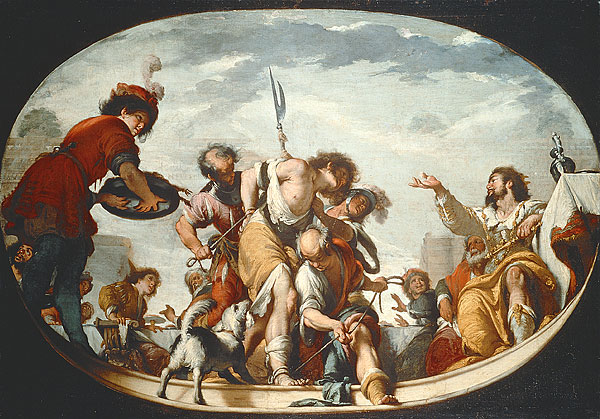
In today’s Gospel (Mt 22:1–14), Jesus continues to speak to us in parables. The kingdom of heaven is compared to a king who prepares a wedding feast — γάμους (gámous) — for his son, and sends his servants to summon those who have been invited: δεῦτε εἰς τοὺς γάμους (deûte eis toùs gámous), ‘Come to the wedding feast’.
This ‘wedding feast’ to which we are invited challenges us at a profound level, calling into question the very quality of our lives.
To take part in a wedding feast means consenting to encounter reality: allowing ourselves to be challenged by the meaning of life, by love, fruitfulness, family, fatherhood and motherhood. Symbolically, the wedding feast gathers together all that a human life tends towards: to love and to be loved, to become fruitful, to discover something for which life is truly worth living.
We cannot live without being in love; without allowing our capacity to love to take on a fruitful form; without some profound meaning which, even amid difficulty, weariness and suffering, enables us to continue wearing, at whatever age, the ‘wedding garment’: ἔνδυμα γάμου (éndyma gámou). To possess a wedding garment means still to have a destination, a passion, something for which to rise each morning; it means continuing on the journey without allowing life gradually to extinguish what is alive within us.
Yet something striking happens in the parable. Those who were invited offer no great reason for their refusal. Matthew simply says: οἱ δὲ ἀμελήσαντες ἀπῆλθον (hoi dè amelḗsantes apêlthon): ‘but they paid no attention and went away’. The verb ἀμελέω (ameléō) means to neglect, to disregard, to consider something unworthy of one’s attention.
And perhaps this is precisely one of the greatest dangers in our lives: not necessarily rejecting what truly matters, but simply ceasing to care about it.
The guests in the parable go off, ‘one to his farm, another to his business’: ὃς μὲν εἰς τὸν ἴδιον ἀγρόν, ὃς δὲ ἐπὶ τὴν ἐμπορίαν αὐτοῦ. Attending to ‘our own affairs’ can become the great deception by which we gradually cease to encounter reality and truly to live it. We concern ourselves with countless things, fill our days, defend our own spaces, pursue problems, commitments and interests; and, almost without noticing it, we can evade the challenge of truth and condemn ourselves to becoming increasingly solitary people, compelled to fill our lives with an endless succession of substitutes.
The Lord, however, continues to invite us: δεῦτε εἰς τοὺς γάμους, ‘Come to the wedding feast’.
And he continues to ask of us the ‘wedding garment’ too, the ἔνδυμα γάμου. For it is not enough merely to enter the hall: we must allow ourselves to become part of the feast. It is not enough to be called: we must allow that call to change something within us.
The Lord continues to offer us this possibility despite our distraction, our fear, our unease, our sense of inadequacy, or simply our being too preoccupied with ‘our own affairs’.
In essence, he continues to offer us a dignity: the possibility, and the strength, to become the people we are capable of becoming and are called to be.
Perhaps the question this Gospel places before us today is a very simple one: what is there in my life that I no longer consider worthy of my attention?
For it may be precisely there that the Lord is still inviting me to the wedding feast.
The Gradual for today’s celebration is taken from Psalm 22 (Ps 22:4), with the following text:
Si ambulavero in medio umbrae mortis, non timebo mala: quoniam tu mecum es, Domine.
Virga tua, et baculus tuus, ipsa me consolata sunt
(Even though I should walk in the midst of the shadow of death, I would fear no evil, for you are with me, O Lord.
Your rod and your staff, they have comforted me).
The accompanying Gregorian chant is taken from the Graduale Triplex, published at Solesmes in 1979. The recording may be found on YouTube, where no information is provided regarding the performers.
A blessed Sunday and heartfelt greetings.