Twentieth Sunday in Ordinary Time/A
Massimo Palombella
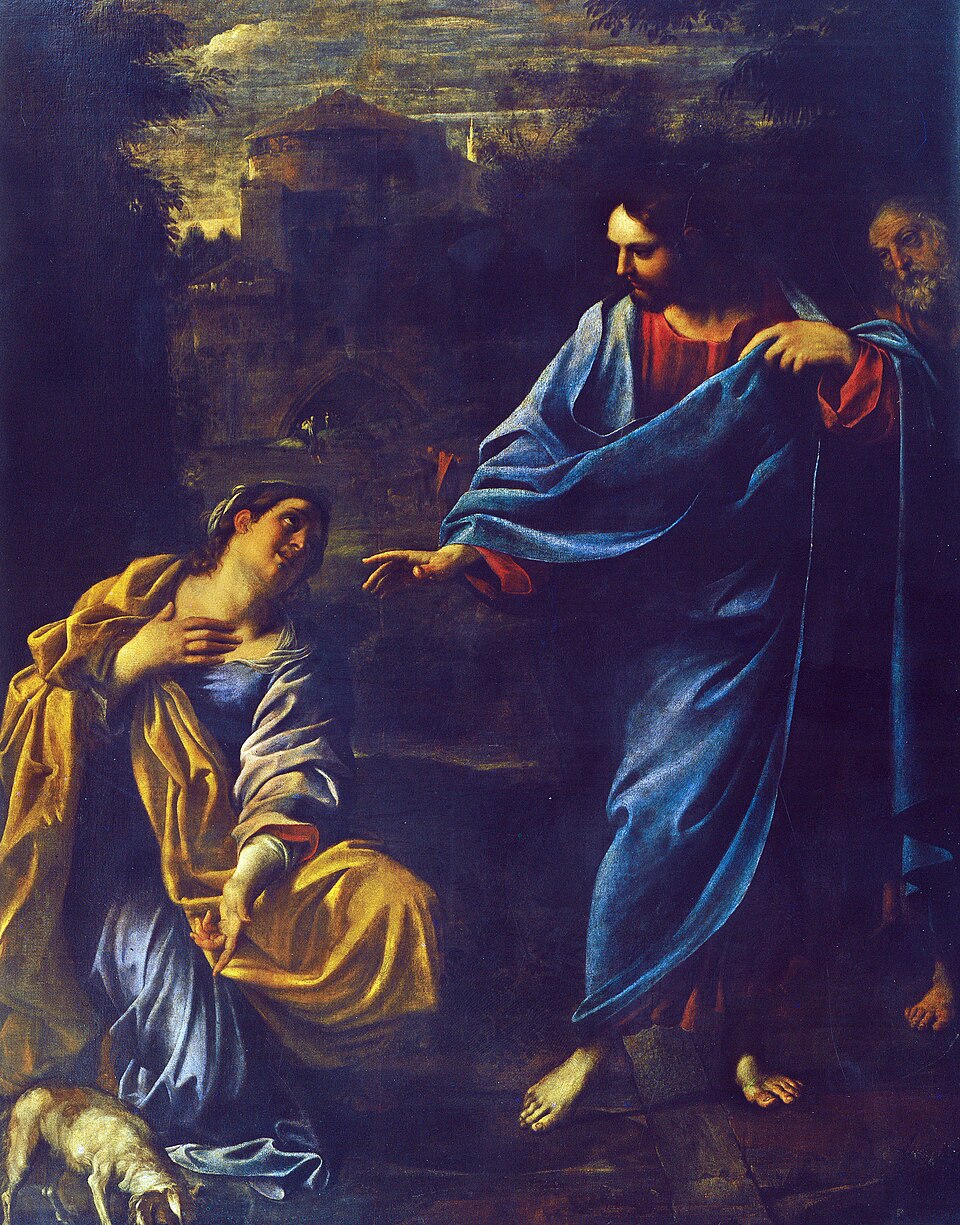
In today’s Gospel (Mt 15:21–28), we are told the story of the Canaanite woman who turns to Jesus for help on behalf of her sick daughter.
Two aspects of this woman are particularly striking: her willingness to ask for help and her persistence. At verse 22, the Greek text uses the verb ἔκραζεν — ékrazen, “she was crying out”, “she kept crying out”, the imperfect of κράζω — krázō. The imperfect suggests an action that is sustained and insistent: not simply “she cried out”, but she kept on crying out. And indeed, shortly afterwards, the disciples ask Jesus to intervene because “she is crying out after us”: κράζει ὄπισθεν ἡμῶν — krázei ópisthen hēmôn. The woman’s perseverance is thus inscribed in the very form of the verb.
I am able to ask for help only if I first acknowledge my weakness, my need. In a sense, asking for help is the first great movement of liberation in my life, precisely because I have become aware that my life no longer “works”, that something is not as it should be, and because I am also prepared to relinquish the comforts and securities I may still possess within a life that no longer “works”.
By analogy, we might think of blind Bartimaeus in the Gospel of Mark (Mk 10:46–52). He finds the courage to cry out to Jesus, but when Jesus calls him he is also able to cast aside his cloak: ἀποβαλὼν τὸ ἱμάτιον αὐτοῦ — apobalṑn tò himátion autoû. Mark does not merely say that he leaves it behind: he uses ἀποβάλλω — apobállō, “to cast away”. Bartimaeus frees himself from what until that moment had wrapped around him; he springs to his feet and goes towards Jesus.
It is also significant that the man who at the beginning “was sitting beside the road”, ἐκάθητο παρὰ τὴν ὁδόν — ekáthēto parà tḕn hodón, is found at the end “following him on the road”, ἠκολούθει αὐτῷ ἐν τῇ ὁδῷ — ēkoloúthei autō̂ en tē̂ hodō̂. If Bartimaeus is to allow his life to be changed, he must also be willing to leave behind what belonged to his former condition.
Today, I too may find myself, like the Canaanite woman, with a sick daughter, or, like Bartimaeus, begging while wrapped in a cloak… I will be able to ask for help only if I recognise that this situation needs to change, that remaining in it does not express the truth of who I am.
Then, like the Canaanite woman or the blind man, I too will be able to be “persistent”, not out of selfishness, but because I have recognised that such a situation does not speak the truth of my life. Perseverance thus becomes a refusal to resign myself to whatever prevents me from living in the truth.
And the Lord will save me; he will lead me into the truth, which alone is true and genuine freedom.
The Communion antiphon appointed for today’s celebration is taken from chapter 21 of the Gospel according to Matthew (Mt 21:13), with the following text:
Domus mea domus orationis vocabitur, dicit Dominus:
in ea omnis, qui petit, accipit; et qui quaerit, invenit; et pulsanti aperietur.
(My house shall be called a house of prayer, says the Lord:
there, whoever asks receives; whoever seeks finds; and to the one who knocks, the door shall be opened).
The accompanying music is taken from the Graduale Triplex, published at Solesmes in 1979. The performance is by Die Singphoniker, under the direction of Godehard Joppich. The recording may be found on the CDGregorian Chant from St. Gall, Vol. 1, reissued in 2013 by NAXOS of America; the original album was released by CPO in 1994.
A blessed Sunday and heartfelt greetings.