Solemnity of the Assumption of the Blessed Virgin Mary
Massimo Palombella
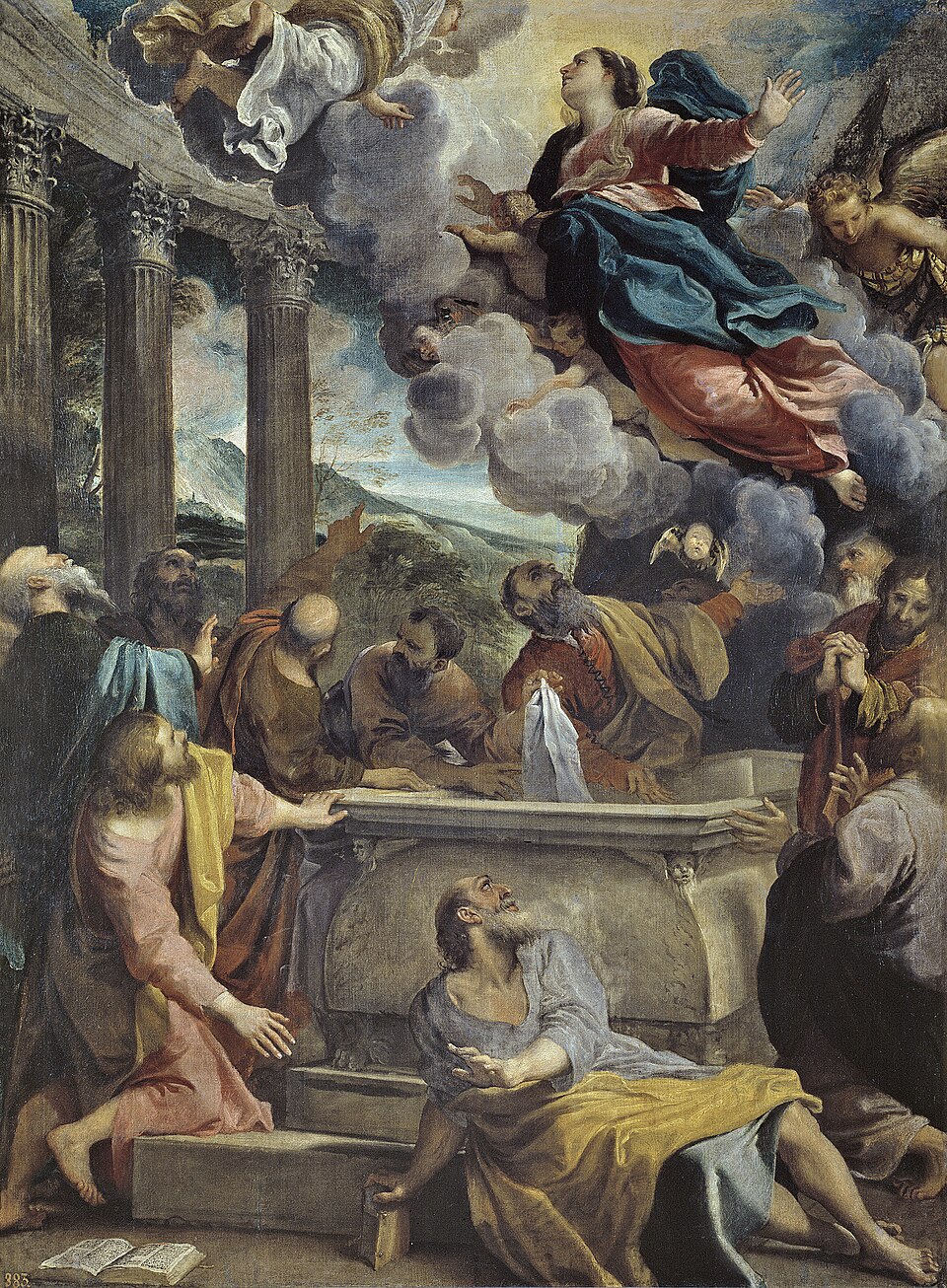
Man was created to see God. Everything else acquires its meaning in the light of this vocation. The Solemnity of the Assumption does not celebrate, first and foremost, a privilege granted to the Mother of the Lord, but the fulfilment of humanity in Mary. In her, we contemplate that for which every human person was created.
Saint Augustine expresses this truth in words that have echoed through the centuries: “You have made us for yourself, and our heart is restless until it rests in you” (Confessions, I, 1). The restlessness that dwells within the human heart is not a weakness, but a sign of its greatness. No finite reality can satisfy the desire for the infinite that inhabits us, because we were made for God. Eternity is not simply life without end, but full communion with Him, culminating in the contemplation of His face. This is the blessedness to which every human being is called.
For this reason, the body too belongs to our destiny. The body is not a mere covering of the soul, nor an instrument at our disposal. It is the concrete manner in which the person exists, enters into relationship, loves and gives of himself. This is why the Christian faith professes the resurrection of the body. The fulfilment of the human person does not consist in leaving the body behind, but in bringing it to its fullness. The glorified body will be wholly consonant with the condition of eternity, where the categories of space and time no longer apply. Nor will it be alien to our history: it will be the body of the very same person whom God will call to resurrection, and in it the truth of what we have become will be revealed once and for all.
History is the place in which freedom gives form to the person. Every choice transforms us. Nothing that we decide remains external to us: every decision contributes to the shaping of the person we are becoming. Every act of love enlarges the heart; every turning in upon ourselves constricts it. Man does not become fully himself through isolated good actions, but when love becomes the very form of his existence. Eternity will not erase this history, but will bring it to fulfilment.
Freedom is the greatest gift God has entrusted to man. Not simply because it allows us to choose among different possibilities, but because through our choices we become what we are. It is precisely this capacity for free choice that truly makes us the image and likeness of God. Freedom entails the risk of refusal, but without that risk there could be no possibility of love. Love, indeed, cannot be imposed: it can only be received and returned.
Mary is the fully realised expression of this freedom. Her “Fiat” is the decision by which she entrusted her entire existence to God. For this reason, her Assumption is not merely a personal privilege, but an anticipation of what God desires to bring about in every person who opens himself or herself to His love.
To celebrate Our Lady’s Assumption is therefore to allow ourselves to be confronted by a decisive question: what kind of man, what kind of woman am I becoming?
Every choice gives form to our life. And it is precisely that form, matured within history, that will one day stand before God and contemplate His face.
The Gregorian Alleluia for today’s Solemnity has the following text:
Alleluia. Assumpta est Maria in caelum: gaudet exercitus angelorum.
(Alleluia. Mary has been assumed into heaven: the host of angels rejoices).
The accompanying music is taken from the Graduale Triplex, published at Solesmes in 1979.
The performance is by CantArte Regensburg. The recording may be found on the CD “Die schönsten Mariengesänge & gregorianische Gesänge an Marienfesten”, released in 2013 by Crystal Classics.
A blessed Solemnity and heartfelt greetings.