Twenty-First Sunday in Ordinary Time/A
Massimo Palombella
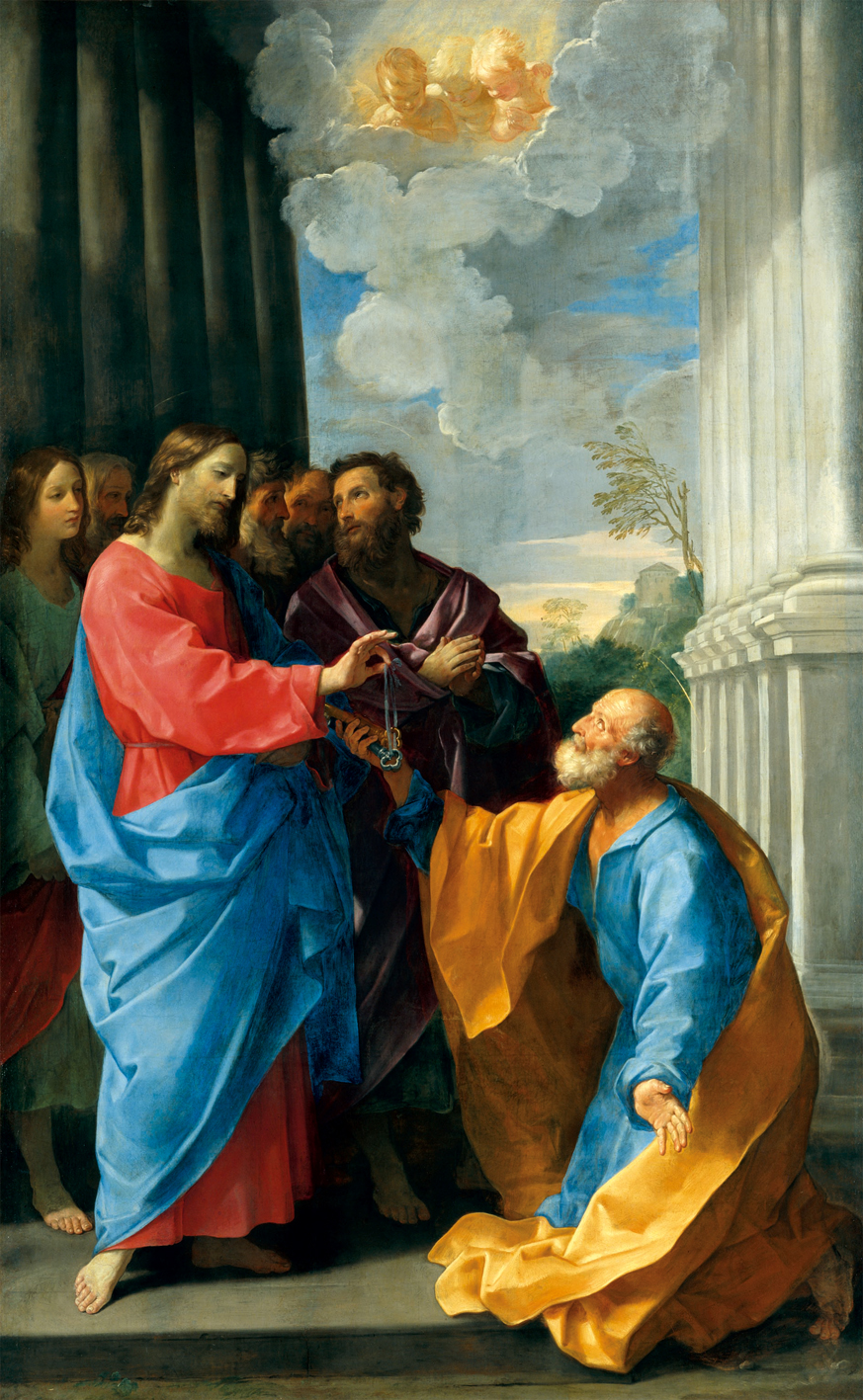
In today’s Gospel (Mt 16:13–20), Jesus puts an essential question to his disciples: ‘But who do you say that I am?’ The Greek text places particular emphasis precisely on that ‘you’: ὑμεῖς δὲ (hymeîs dè), ‘but you’. It is no longer a matter, then, of reporting what others think about Jesus, but of taking a personal stand before him.
When Peter replies, ‘You are the Christ, the Son of the living God’, Jesus answers by revealing to Peter something of his own identity: ‘You are Peter, and on this rock I will build my Church.’ The movement here is striking: Peter says who Jesus is, and immediately Jesus tells Peter who Peter is.
In a certain sense, the same thing happens in our own lives. Whenever we make room for the Lord, whenever we recognise his presence and his concrete significance within our existence, the Lord does not diminish our lives; rather, he strengthens our identity and broadens our horizons.
In this connection, it is worth recalling Peter’s first encounter with Jesus, as recounted by the evangelist Luke (Lk 5:1–11). Peter, to the extent that he is able at that moment, places his trust in Jesus and, after a night spent catching nothing, says to him: ‘At your word I will let down the nets.’ Peter does not yet possess a mature faith; he does not yet fully understand who stands before him. He simply allows the word of Jesus a place within his own experience. And it is precisely from that space that something new can begin.
Indeed, in seeking to establish a personal relationship with Peter, Jesus does not force himself upon Peter’s life; he does not ask him to become something alien to who he is. Peter is a fisherman, and Jesus begins precisely there: ‘From now on you will be catching people.’ He does not erase Peter’s history, but opens it to a new horizon. He does not take away what Peter is, but enables him to become it more deeply.
It is a journey which, passing also through weakness, misunderstanding and failure, will lead Peter eventually to the words of today’s Gospel: ‘You are Peter, and on this rock I will build my Church.’
The question Jesus addresses to his disciples today is therefore addressed personally to each one of us as well: ‘Who do you say that I am today?’ In other words: who am I for you? What place do I truly have in your life? By what criteria do you make your choices, imagine your future, pass through difficult moments, and interpret what happens to you?
It is an essential question, one that asks of each of us an equally essential answer. Not necessarily, first and foremost, an answer made of words, but an answer that gradually takes shape in the way we live.
And throughout this process, one certainty remains: every space we make for the Lord, however small, can become—as it did for Peter—a place in which our identity becomes clearer, our life acquires meaning, and our horizons widen.
For the Lord does not lead us away from who we are: he leads us towards the deepest truth of what we can become, and of what we are called to be.
The text of the Alleluia verse in Gregorian Chant for today’s celebration is taken from Chapter 16 of the Gospel according to Matthew (Mt 16:18), with the following words:
Alleluia. Tu es Petrus, et super hanc petram aedificabo Ecclesiam meam.
(Alleluia. You are Peter, and on this rock I will build my Church).
The accompanying music is taken from the Graduale Triplex, published at Solesmes in 1979.
The recording is available on YouTube, where no information is provided regarding the performers or the interpretation.
A blessed Sunday and heartfelt greeting.