Solemnity of the Ascension of the Lord
Massimo Palombella
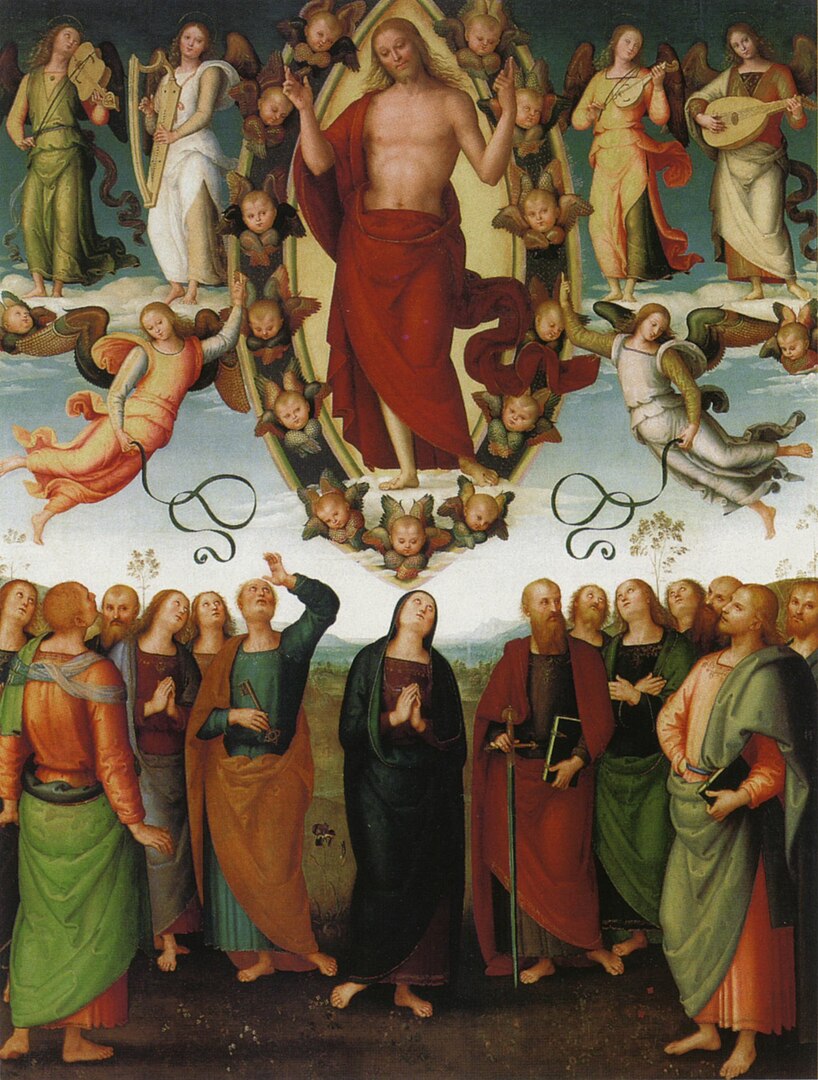
Today’s celebration commemorates Jesus’ ascension into heaven 40 days after Easter and its correct liturgical location should be on Thursday of the 6th week of Easter (exactly 40 days after Easter). In countries where this solemnity is not a holiday, it is postponed to the following Sunday, the 7th of Easter Time.
The origin of this celebration is attested from the 4th century and in the 15th century it had an octave, which was later suppressed by Pope Leo XIII in favour of the Pentecost novena.
The ascension of the Lord makes it clear that our humanity is enabled to see God, to be with God. In fact, ancient iconography always depicts the glorious Christ with the signs of the Passion, to indicate that his humanity, all his humanity – even suffering, pain – is forever in the glory of God.
The Ascension is also the separation of Jesus from the Apostles, that separation that allowed the Apostles themselves to move from an “emulation” of Jesus to a metabolisation of him in their humanity. Only this process, not easy and not taken for granted, led the Apostles to that “personal” relationship with the Lord where they could encounter the truth of their identity, without losing anything of their humanity.
Each one of us, like the Apostles, should move from “emulation” to “personalization” of life, and we can only accomplish this journey by accepting separation, experiencing bewilderment, to slowly become aware of our own resources. “Separation” is an inner process (which often begins with an outer act) and is what makes us adults. Separation from our father, from our mother, from a received image of God, from behavioural styles that served and were effective at a specific time in our lives. Separations, painful as they are, bring us ever closer to truth, to healthy autonomy, to the true God. To avoid separations is to remain entangled in a kind of survival where the mainstay of our lives is not being adults but remaining adolescents.
Saint Leo the Great writes: “Today, the Son of Man made himself known in the most sublime and holiest manner as the Son of God, when he re-entered into the glory of the majesty of the Father, and began in an ineffable manner to make himself more present by his divinity, he who, in his visible humanity, had become more distant from us” (from the “Discourses” of Saint Leo the Great, Pope [Discourse 2 on Ascension 1, 4; PL 54, 397-399]).
The “ad libitum” Offertory antiphon for today’s celebration is taken from chapter 1 of the Acts of the Apostles (Acts 1:11) and reads as follows:
Viri Galilaei, quid admiramini aspicientes in caelum?
Hic Iesus, qui assumptus est a vobis in caelum,
sic veniet, quemadmodum vidistis eum ascendentem in caelum, alleluia.
(Men of Galilee, why do you gaze at the sky in astonishment?
This same Jesus who was taken up from you into heaven,
will come by the very way in which you saw him go into heaven, alleluia).
The attached music, in Gregorian chant, is taken from the Graduale Triplex published at Solesmes in 1979. The performance is by the “Choeur des moines de l’Abbaye de Solesmes” conducted by Jean Claire. The track can be found on the CD “Abbaye de Solesmes. Ascension. Pentecote. Trinite” released by Decca Records France in 1972.
A blessed Sunday, happy Solemnity of the Ascension of the Lord, and heartfelt greetings.