Fourth Sunday of Ordinary Time/A
Massimo Palombella
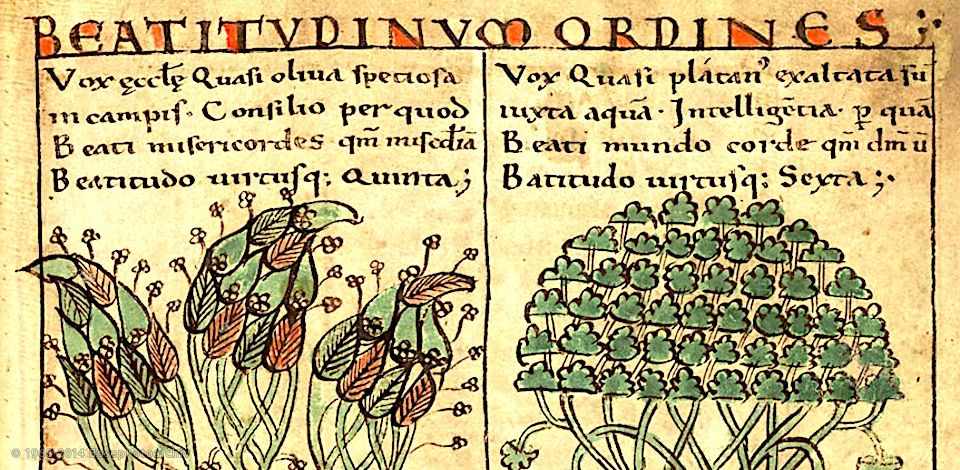
In today’s Gospel (Mt 5:1-12a) Jesus went up the mountain and, having sat down, teaches his disciples through the beatitudes.
Within a somewhat naive and superficial understanding of reality, we are subtly tempted to identify being blessed with a precise historical condition. Thus, finding myself poor, sad and persecuted would put me in a “privileged” position in terms of happiness, of my relationship with God. In essence, in this naive view, it is as if there were a kind of ‘pole position’ in order to salvation, a situation in which I find myself, regardless of my choices.
But, absolutely beyond this ideological view of reality, the beatitudes touch the essence of our being in the image of God, namely our freedom. Indeed, it is only the exercise of our freedom, through the concrete choices we make, that defines our identity, makes us ‘blessed’ or not.
Similarly, defining that hell cannot exist if we believe in a God who is love and mercy, implicitly means denying our freedom which is exactly what we can say we are, by His gift, like God.
We can absolutely define our lives, either by opening ourselves to God’s plan or by denying it. And God is such because He does not go beyond our freedom, does not break that thin line beyond which there would be no more dignity, and we would be nothing more than ‘puppets’ handled by a great master.
It is I who choose to be poor, crying, meek, pure of heart, hungry and thirsty for justice, merciful, peacemaker, persecuted for justice and reviled. It is I who, not without effort and in relation to my abilities, decide the horizon, the challenges, the quality of my life. The God in whom we believe is close to us in our suffering, sustains us in our fatigue, is rich in mercy more than any of our imaginations, but he does not replace us, he does not evade us the possibility of becoming through our freedom the people we can and should be.
The Gradual for today’s celebration is taken from Psalm 112 (Ps 112:5, 6, 7) with the following text:
Quis sicut Dominus Deus noster, qui in altis habitat,
et humilia respicit in caelo et in terra?
Suscitans a terra inopem, et de stercore erigens pauperem
Who is like the Lord our God who dwells on high
and looks down on that which is humble in heaven and on earth?
He raises the needy from the earth and lifts up the poor out of the mire).
The attached music, in Gregorian chant, is taken from the Graduale Triplex published in Solesmes in 1979. The interpretation is by the Mönchsschola der Erzabtei St.Ottilien, conducted by Johannes Berchmans Göschl. The music track can be found on the CD Gregorian Chants, published by Profil in 2014.
A blessed Sunday and heartfelt greetings.