Feast of the Baptism of the Lord/A
Massimo Palombella
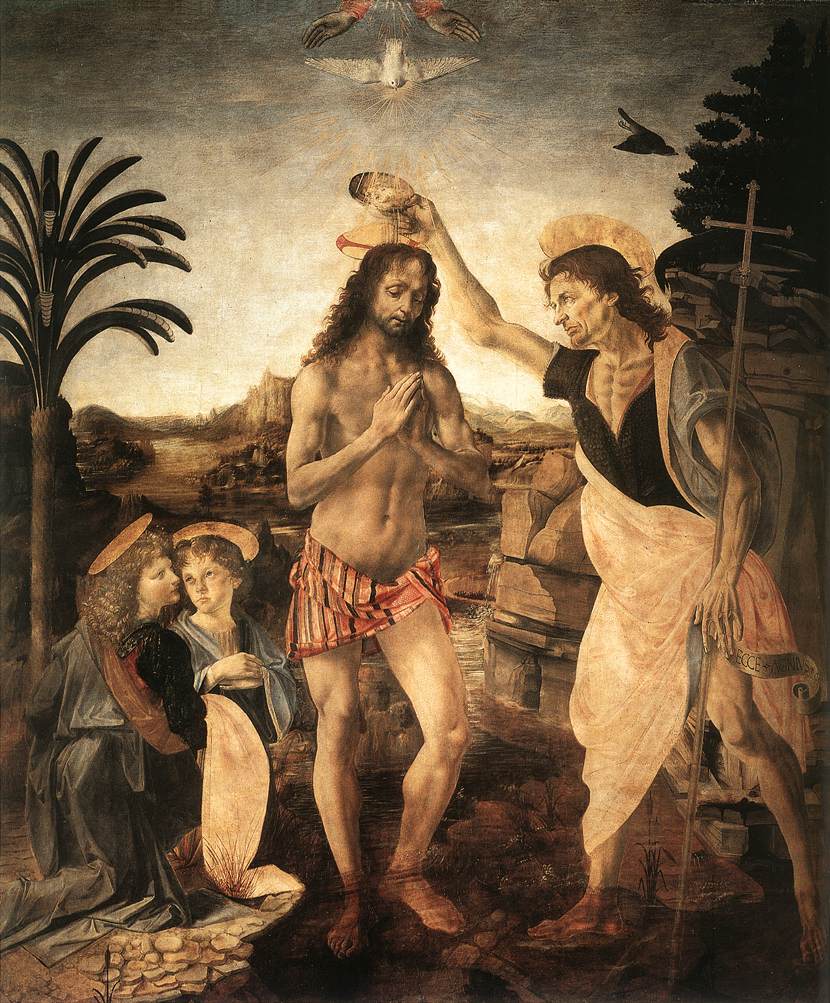
Leonardo da Vinci (1452–1519) , Baptism of the Lord (Palazzo degli Uffizi, Firenze)
In ancient times the Churches of Byzantine tradition called this feast “Epiphany” where three manifestations of Jesus were united: the adoration by the Magi (Mt 2,1-12), the Baptism of Jesus in the Jordan (Mt 3,13-17) and the first miracle that took place in Cana of Galilee (Jn 2,1-11).
In the current Liturgy this feast is not theologically distinct from the Epiphany, except for a different emphasis. In the Roman and Ambrosian rites the three above-mentioned manifestations of Jesus are separated into three days: the Epiphany and the two following Sundays.
With today’s feast we enter a segment of Ordinary Time (which will lead us to Ash Wednesday) that has a marked Christological accent, in the sense that it focuses specifically on the identity of Jesus.
The Lord manifested himself at Christmas and with many signs reveals his identity.
We often fail to recognize him in the events of our lives because we look for him with pre-established schemes, we expect him through clear cut expectations.
Perhaps we need to look for the Lord in what is fragile, in what is not certain, in what is not taken for granted.
Perhaps we need to look for him beyond the horizons we have given ourselves and the plans we have made.
Perhaps that is where he is waiting for us.
The Gradual for today’s celebration is taken from Psalm 71 (Ps 71:18. 3) with the following text: Benedictus Dominus Deus Israel, qui facit mirabilia magna solus a saeculo.
Suscipiant montes pacem populo tuo, et colles iustitiam.
(Blessed be the Lord, the God of Israel, who alone accomplishes great wonders from all eternity.
Let the mountains receive peace for the people, and the hills justice).
The attached music, in Gregorian chant, is taken from the Graduale Triplex published in Solesmes in 1979. The interpretation is by the “Chœur des Moines de l’Abbaye bénédictine de Saint-Benoît-du-Lac” conducted by André Saint-Cyr. The music track can be found on the CD ‘Pax: Gregorian chant on the theme of peace’ published by Analekta in 2010.
A blessed Sunday and heartfelt greetings.