Thirty-Second Sunday in Ordinary Time/B
Massimo Palombella
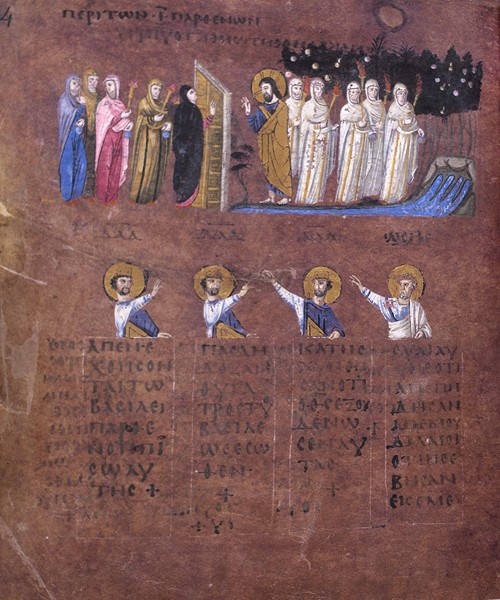
In today’s Gospel (Mt 25:1–13), Jesus, through the parable of the ten virgins, once again reveals the meaning of the ‘Kingdom of Heaven’ (ἡ βασιλεία τῶν οὐρανῶν, hē basileía tôn ouranôn).
It is striking that the fulfilment of our deepest longing, ‘life in abundance’, complete happiness, the ‘Kingdom of Heaven’, should be likened to a wedding feast.
Indeed, a wedding day represents the culmination of a whole series of experiences: falling in love and allowing that love to take shape in a shared vision of life; our existence as sexual beings; the immense power of sexuality finding its fulfilment in fatherhood and motherhood; and the completion of those necessary ‘separations’ through which we become mature adults, capable of truly ‘binding ourselves’ to another. Throughout this process, something profound is at work, something we may not even fully perceive: a certain intelligence of life, the capacity – even without being consciously aware of it – to ‘abstract’, to think beyond what is immediately before us.
It is significant that the Greek text describes the wise virgins as φρόνιμοι (phrónimoi), a term denoting not merely prudence, but the capacity for discernment, for understanding reality and acting with an awareness of the consequences of one’s choices. It is the practical wisdom of those who do not confine themselves to living in the present, but are able to recognise what the present demands in view of the future.
Those who allow themselves to be challenged by the ‘Kingdom of Heaven’, by ‘life in abundance’, by the daring conviction that life in all its fullness is possible, embark upon a process of growing in their ‘understanding’ of life. It is a process that enables us to recognise, before it is too late, that our oil (ἔλαιον, élaion) is running low; that our children need a future worthy of the name; that our wife or husband needs to be cared for and cherished. In essence, we become capable of no longer living merely from one day to the next, of looking ahead, of ‘abstracting’, of becoming like the ‘wise’ virgins of whom the Gospel speaks.
This process is far from easy, nor is it free from temptations and failings. It is worth noting that, in describing the waiting for the bridegroom, the Gospel explicitly states: «ἐνύσταξαν πᾶσαι καὶ ἐκάθευδον» – ‘they all became drowsy and fell asleep’ (Mt 25:5). Even the wise virgins experience weariness, sleep and the burden of waiting. What distinguishes them is not that they have never known frailty, but that they have preserved what enables them to face it without losing sight of the direction of their lives.
Thus, ‘falling’, ‘no longer feeling the desire to carry on’, losing our ‘zest for life’, however painful these experiences may be, can find their place and their resolution within a larger purpose in life, within a love that endures despite our failings and our infidelities.
We can then understand the significance of the imperative with which Jesus concludes the parable: γρηγορεῖτε(grēgoreîte), ‘Keep watch’ (Mt 25:13). This is not simply a matter of remaining awake, but of refusing to lose the capacity to recognise what truly matters, to keep our deepest longing alive, and to continue giving direction to our existence.
At every stage of our lives, the Lord continues to challenge us, asking us to be courageous and to relinquish our certainties. He asks us not to abandon an ‘intelligent understanding’ of life. He waits for us when we struggle; He takes us by the hand when we can no longer walk; He continues to tell us the truth even when we no longer wish to hear it. He loves us in precisely the way we need to be loved, so that we may become the men and women we are capable of becoming, and are called to be.
The Communion Antiphon for today’s celebration is taken from Chapter 25 of the Gospel according to Matthew (Mt 25:4, 6), and has the following text:
Quinque prudentes virgines acceperunt oleum in vasis suis cum lampadibus: media autem nocte clamor factus est:
Ecce sponsus venit: exite obviam Christo Domino.”
(‘The five wise virgins took oil in their vessels along with their lamps.
At midnight a cry was heard: “Behold, the bridegroom is coming! Go forth to meet Christ the Lord”’).
The accompanying Gregorian chant is taken from the Graduale Triplex, published at Solesmes in 1979. The performance is by the Cantori Gregoriani · Stirps Iesse, directed by Giacomo Baroffio. The recording is included on the CD Capolavori Gregoriani (‘Masterpieces of Gregorian Chant’), released by Paoline Editoriale Audiovisivi in 2007.
A blessed Sunday and heartfelt greetings.