Nineteenth Sunday in Ordinary Time/A
Massimo Palombella
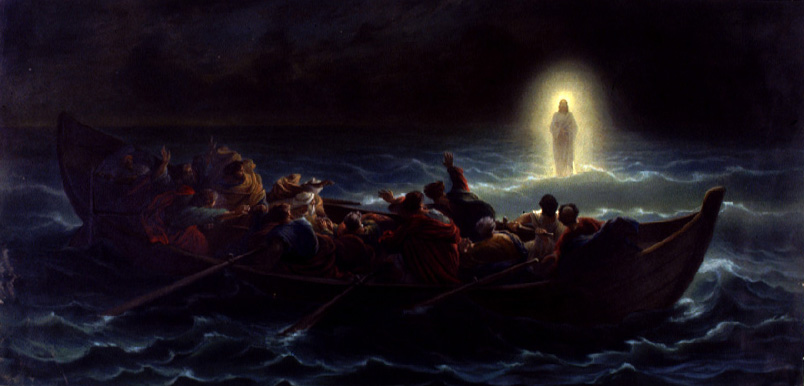
Today’s Gospel presents us with the celebrated account of Jesus walking upon the waters.
There is one detail, however, which seems to me particularly worthy of attention, though it often passes unnoticed. Saint Matthew tells us that Jesus made the disciples get into the boat. The verb he employs is ἀναγκάζω (anankázō): it means to compel, to oblige, to constrain. This is no gentle invitation, but a deliberate command.
That single detail transforms the way we read the entire narrative. The disciples are not caught in the storm because they have taken a wrong course, nor because they have strayed from the Lord. On the contrary, their trial is born precisely of their obedience. They find themselves in that situation because they have listened to Christ.
The boat is described as being battered by the waves. Here Matthew uses the verb βασανίζω (basanízō), a word that evokes torment: a trial that wears one down little by little. The wind, moreover, is ἐναντίος (enantíos)—contrary, hostile. It is the darkest watch of the night.
And it is precisely there, in the very heart of the storm and of their fear, that Jesus comes walking upon the waters to meet His disciples. He does not wait for them on the shore; He reaches them in the midst of the raging sea.
Peter himself, who steps out of the boat to go towards Him, begins to sink the moment he takes his eyes off Jesus and fixes them instead upon the wind. Fear overwhelms him.
When we read this passage attentively, each of these details acquires remarkable depth.
The disciples enter the boat in obedience to Christ, only to find themselves in a situation where all their certainties begin to fail. Peter shifts his gaze from Jesus to his own fear, and he begins to sink.
Fear touches countless dimensions of our lives. When it goes unrecognised, it can come to govern even our most important decisions: the fear of being left alone; of failing to fulfil one’s vocation in life; of not being esteemed; of growing old; of seeing shattered the image we have carefully fashioned of ourselves.
When fear is not confronted, it narrows our horizons and imprisons us within an illusion of security which, in reality, prevents us from truly living.
To fix our gaze upon the Lord, and to live in the truth, leads us into the deepest truth about ourselves. There we are enabled to face those unresolved wounds and hidden knots from which our fears arise.
It is precisely there that the Lord awaits us. Not in order to deny what frightens us, but to reach us in the midst of the storm and to speak once more those words that resound throughout the whole of Sacred Scripture: “Take heart; it is I. Do not be afraid.”
Not to remove the trial, but to teach us to trust—to surrender ourselves, little by little, to His guidance, until we become the person we are both capable of being and called to be.
The Gregorian Alleluia appointed for today’s celebration is taken from Psalm 89 (Psalm 89:1), with the following text:
Alleluia. Domine, refugium factus es nobis a generatione et progenie.
(Alleluia. O Lord, You have been our refuge from generation to generation.)
The musical setting reproduced here is taken from the Graduale Triplex, published by the Abbey of Solesmes in 1979. The performance is by the Schola of the Benedictine Abbey of Gerleve, directed by Gottfried Meier. The recording appears on the album Gregorian Chants, released in 2013 by T2 International BV.
A blessed Sunday and heartfelt greetings.