Eighteenth Sunday in Ordinary Time/A
Massimo Palombella
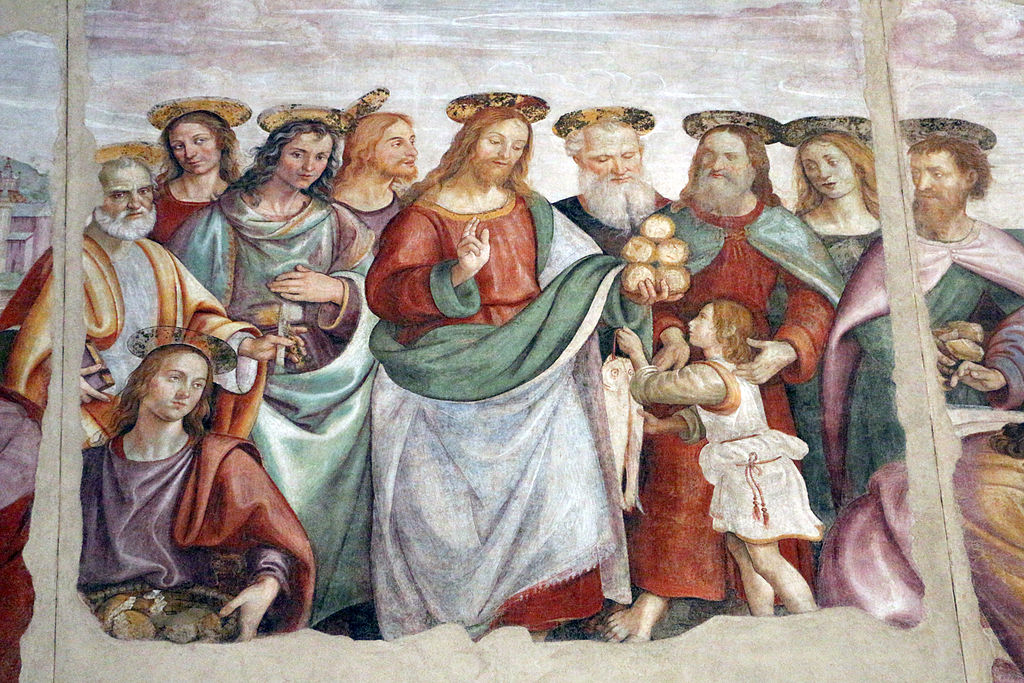
This Sunday’s Gospel opens with a movement of Jesus that deserves our careful attention. Having heard of the death of John the Baptist, “he withdrew by boat to a deserted place, by himself.”
The evangelist Matthew employs the verb ἀνεχώρησεν (anechṓrēsen). It does not denote a flight prompted by fear, but rather a deliberate withdrawal in order to enter more deeply into the Father’s appointed time. With the death of the Baptist, a new phase in Jesus’ mission begins. His withdrawal is not an escape: it is an act of discernment. It is the way in which Jesus remains wholly within the Father’s saving purpose.
The place itself is equally significant. Matthew describes it as ἔρημος (érēmos): the wilderness. In Scripture, the wilderness is not primarily a geographical location, but the place of testing, of silence, of what is essential, and of a true encounter with God. It is the place where illusions fall away and only what truly matters remains.
Perhaps the summer season offers us precisely this opportunity: to step outside our ordinary routines, if only for a few days, and to inhabit a different rhythm of time. Not merely to interrupt our work, but to rediscover an inner space in which the Lord may truly meet us. A time and a place that are not necessarily “comfortable”, where we can at last allow room for the questions we usually keep at a distance, for wounds that have yet to heal, and for the deepest hopes, desires and needs of our hearts.
To come to a halt is never easy. We are tempted to fill every moment and occupy every space, as though we were afraid of silence. Yet true rest does not consist simply in doing less; it is found in rediscovering ourselves and the presence of God.
Not the God we fashion for ourselves in the illusion of feeling well, but the living God, who goes before us and awaits us, so that our lives may recover their solidity, their unity and their truth. From this encounter alone is born a life truly worthy of being lived.
The Gradual for today’s celebration is taken from Psalm 144 (145):15–16, with the following text:
Oculi omnium in te sperant, Domine: et tu das illis escam in tempore opportuno.
Aperis tu manum tuam: et imples omne animal benedictione
(The eyes of all look to you in hope, O Lord, and you give them their food in due season.
You open your hand and satisfy every living creature with your blessing).
The accompanying music is taken from the Graduale Triplex, published at Solesmes in 1979. The performance is by the Coro de Monjes del Monasterio de Silos, directed by Ismael Fernández de la Cuesta. The recording is available on the album Coro de Monjes del Monasterio de Silos, released by Parlophone Music Spain S.A.in 1999.
A blessed Sunday and heartfelt greetings.