Solemnity of Pentecost
Massimo Palombella
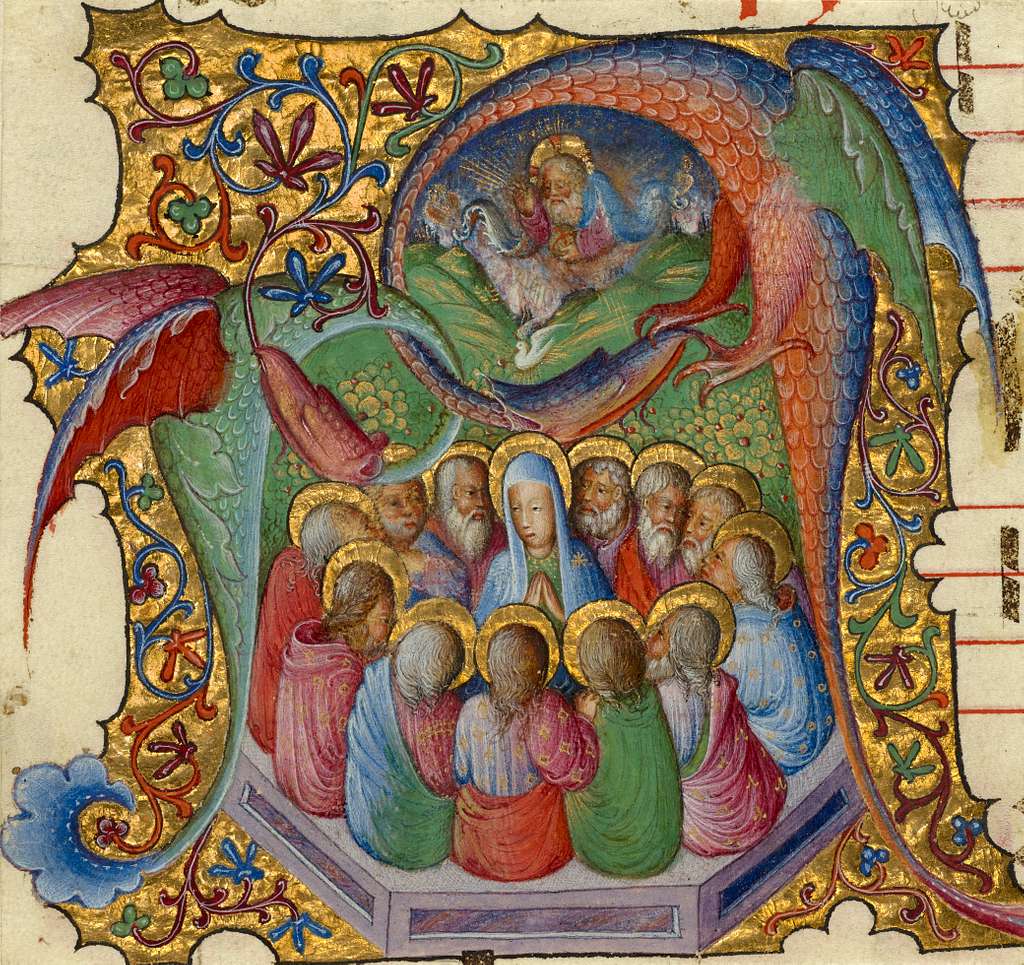
The Ascension does not leave behind an emptiness.
The distance of Christ opens within us the space of the Spirit.
Jesus withdraws from human sight so that He may dwell in the depths of the soul.
The Holy Spirit is given to us so that we may “know”: not with a knowledge that grasps or possesses, but with a light that transfigures.
Saint Cyril of Alexandria writes that the Spirit, abiding within man, transforms him “into another image” (In Ioannis Evangelium, XI, 11).
Whoever allows himself to be inhabited by the Spirit no longer remains enclosed within himself, but is gently led towards the Truth.
Michelangelo understood that every true work of art comes not from adding, but from removing. The form already dwells hidden within the marble; the task is to free it from all that imprisons it.
So too does the Spirit work within us.
He does not place spiritual masks upon us, but burns away what is superfluous, passes through the hardness of our hearts, and removes all that prevents the Truth from revealing itself.
He leads us, slowly and patiently, towards becoming the persons we can – and should – be before God.
And it is precisely through this “removing”, through allowing ourselves to be hollowed out and purified, that we gradually come to receive life in all its fullness.
The hymn at Vespers for the Solemnity of Pentecost has the following text (in one of the versions used in Rome during the Renaissance):
Veni, creator Spiritus,
mentes tuorum visita:
imple superna gratia
quae tu creasti pectora.
Qui diceris Paraclitus,
altissimi donum Dei,
fons vivus, ignis, caritas
et spiritalis unctio.
Tu septiformis munere,
dextrae Dei tu digitus,
tu rite promissum Patris,
sermone ditans guttura.
Accende lumen sensibus,
infunde amorem cordibus,
infirma nostri corporis
virtute firmans perpeti.
Hostem repellas longius
pacemque dones protinus;
ductore sic te praevio
vitemus omne noxium.
Per Te sciamus da Patrem
noscamus atque Filium,
teque utriusque Spiritum
credamus omni tempore.
Come, Creator Spirit,
visit the minds of thine own;
fill with heavenly grace
the hearts which thou hast made.
Thou who art called the Paraclete,
gift of the Most High God,
living fountain, fire, charity,
and spiritual anointing.
Thou sevenfold in thy gifts,
the finger of God’s right hand,
thou the Father’s promised pledge,
enriching tongues with speech.
Kindle light within our senses,
pour love into our hearts,
and with enduring strength
fortify the frailty of our flesh.
Drive far from us the enemy,
and grant us forthwith thy peace;
so, with thee going before as guide,
may we avoid all harm.
Through thee may we know the Father,
and come to know likewise the Son;
and thee, the Spirit of them both,
may we believe in always.
Glory be to God the Father,
and to the Son who from the dead
rose again, and to the Paraclete,
unto ages of ages.
The attached manuscript is by Giovanni Pierluigi da Palestrina and comes from the Lateran Archive, Codex 59.
The live performance is by the Schola Cantorum of the Veneranda Fabbrica del Duomo di Milano, at the concert held on 20 November 2025 in the Church of San Gottardo in Milan.
A blessed Sunday, a happy Solemnity of Pentecost, and heartfelt greetings.